
News, Publications
Machine learning reveals neurochemical signatures associated with Rett syndrome
Nicolas Panayotis (head of SPPIN Team7) has published a new paper in the Journal of Neuroscience Methods which highlights the potential of machine learning to identify disease-related neurochemical patterns in a mouse model of Rett syndrome.
The work is the result of a fruitful collaboration between the SPPIN (Paris), the CRNL (Lyon), the LaBRI and IMN (Bordeaux) and the Inmed (Marseille). The researchers have developed a machine-learning approach to investigate neurochemical alterations associated with Rett syndrome in the MeCP2-deficient mouse model.
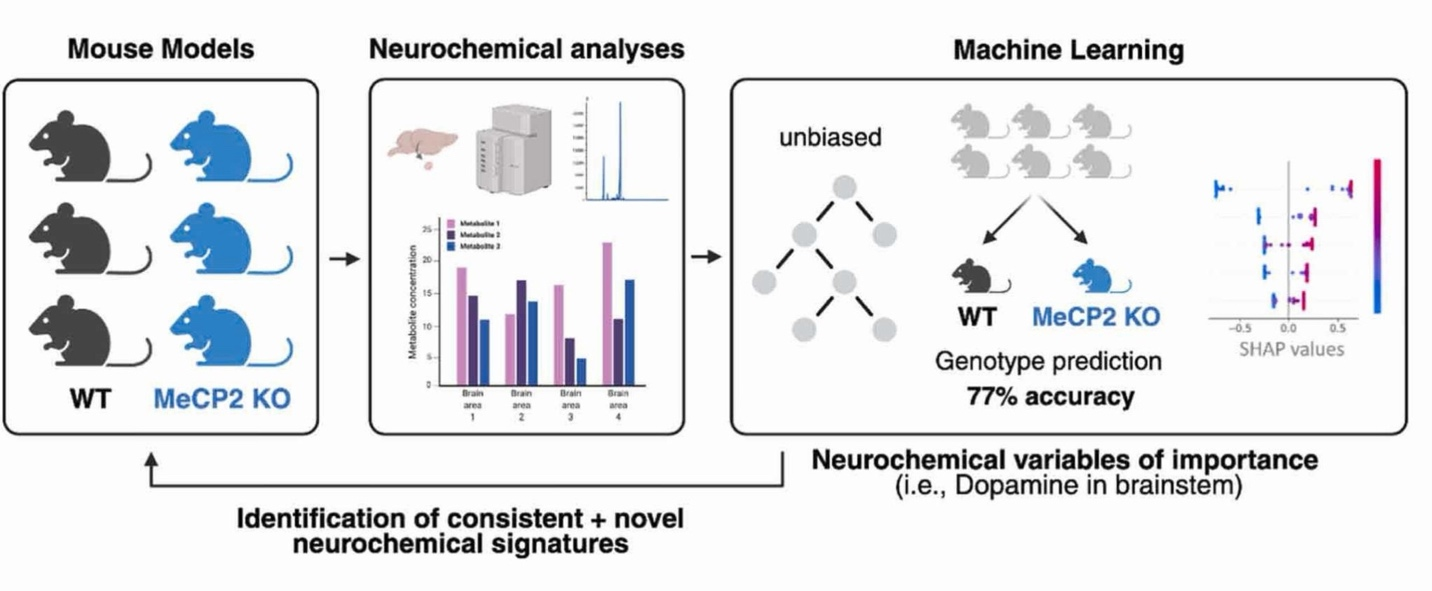
By analyzing neurochemical profiles encompassing 44 variables, the team demonstrated that machine-learning models could predict genotype in a mouse model of the disease. Beyond classification, the approach identified key neurotransmitters, catabolites, and brain regions contributing to this prediction, revealing patterns consistent with previously reported neurochemical alterations associated with Rett syndrome.
These findings illustrate the potential of machine learning not only as a predictive tool but also as a means of extracting biologically meaningful information from complex neurochemical datasets. More broadly, this work opens new perspectives for the analysis and interpretation of neurochemical data in neuroscience research.
Congratulations to all contributors!
Reference:
https://www.sciencedirect.com/science/article/pii/S0165027026002797
Batanga Loko, M.#, Panayotis, N.#, Roux, JC, Alexandre, F., Parrot, S. Machine learning–driven prediction of neurochemical signatures in the Rett syndrome mouse brain. Journal of Neuroscience Methods, Volume 438, 2027. https://doi.org/10.1016/j.jneumeth.2026.110949