News, Publications
Salla disease: SPPIN team reveals why a single mutation causes dysfunction in the sialin transporter
Salla disease is a rare genetic disorder with no current treatment, causing motor delay, and intellectual disability. Its cause lies in mutation of a transporter protein called sialin that is able to transport certain sugars from the interior of the cell organelles called lysosomes to their exterior. One of the most common mutations responsible for the disease is R39C, where one amino acid is swapped for another. This slight change leads to an interruption of the correct functioning of the transporter though how it does this has remained unknown so far.
In a new study recently released as a preprint, the Membrane Dynamics team at SPPIN, in collaboration with Dassault Systèmes BIOVIA, proposes a mechanistic answer to this question.
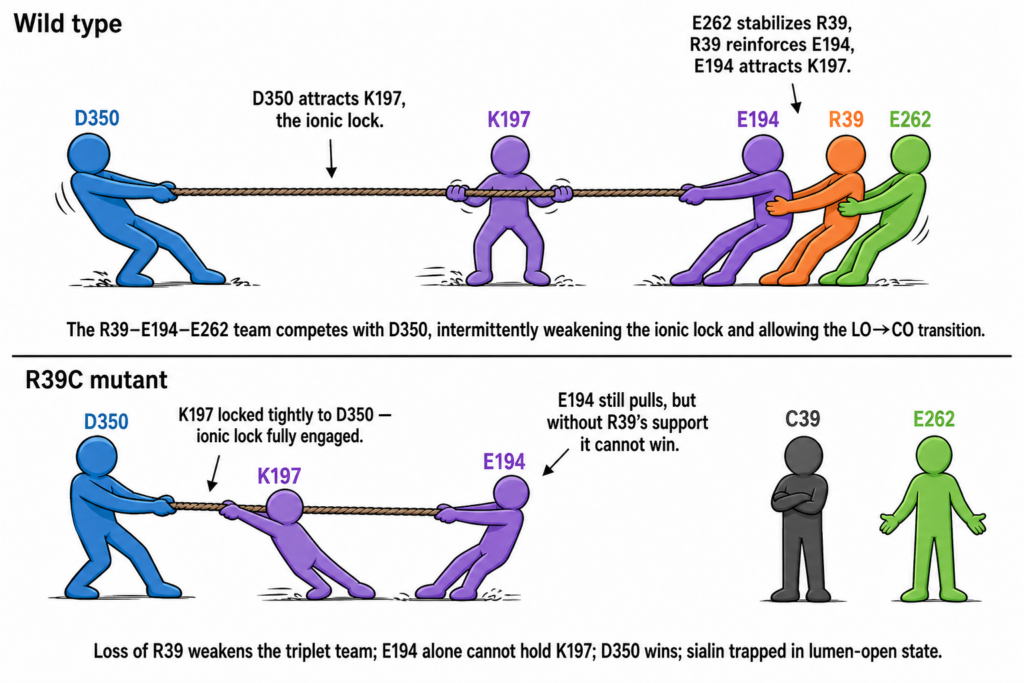
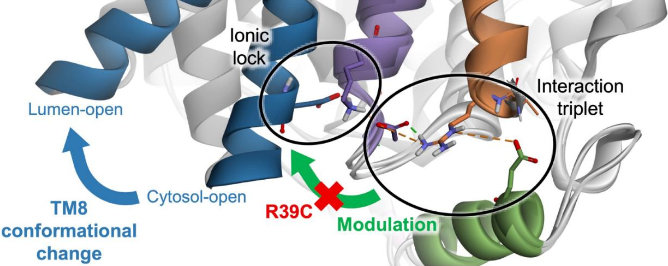
Sialin works as a rocker-switch, opening alternately toward the lysosome and the cytosol. Combining Molecular Dynamics simulations, evolutionary analysis and mutagenesis, the authors identified two key structural features: an interaction triplet (R39, E194, E262) acting as a modulator, and an ionic lock (K197–D350) holding the protein open toward the lysosome. In healthy sialin, the triplet periodically weakens the lock, allowing the switch to flip. In the R39C mutation, the triplet is no longer present leaving the lock permanently engaged and the sugars that would be transported under normal conditions trapped inside lysosomes.
Beyond fundamental understanding of how the transporter works in healthy individuals, this work is the first to provide a molecular level understanding of how Salla disease is caused. The research was supported by the Salla Treatment And Disease foundation, the Dassault Systèmes foundation and the Vaincre les maladies lysosomales foundation.
Reference: https://doi.org/10.64898/2026.04.20.719580