
News, Publications
New SPPIN paper in Nature Neuroscience: Population coding in Purkinje cells drives one-shot motor learning.
The Stell team has published a new paper in Nature Neuroscience : Rapid motor skill adjustment is associated with population-level modulation of cerebellar error signals. Nguyen V, Gros C, Stell BM : Nat Neurosci, 2025
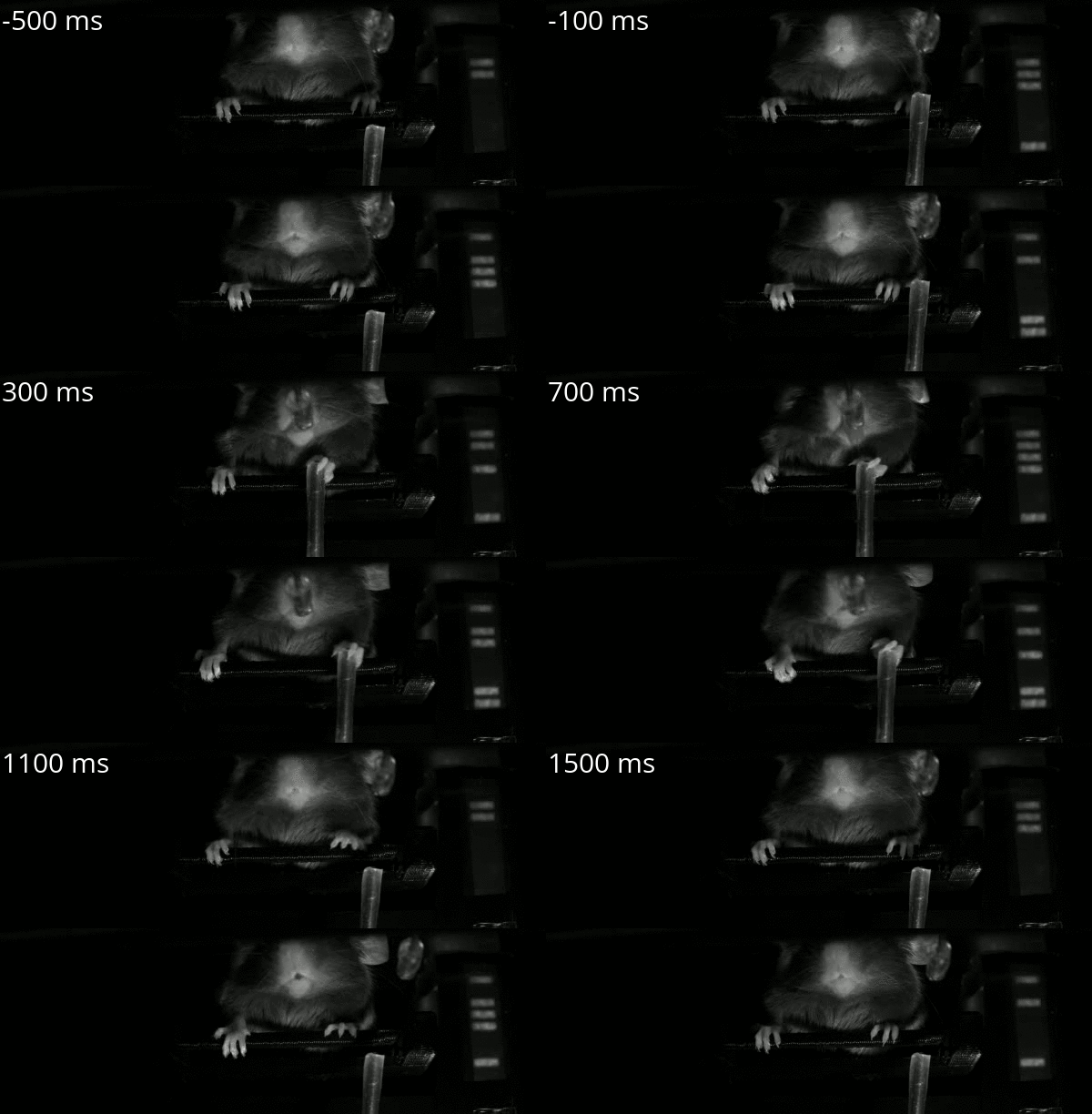
This paper set out to answer a fundamental question in motor learning: How do our brains adapt and learn new movements so quickly? We trained mice to use a joystick to retrieve rewards. To test their adaptation, we imposed a sudden perturbation (a 2x gain; lower panel in the video) that they needed to overcome. Remarkably, much like humans adapting to force-field or visuomotor perturbations, the mice adjusted their movements in only a few pulls.
This speed poses a challenge for classic supervised learning models. Climbing fibers provide error signals to Purkinje cells, but these signals are traditionally viewed as binary: error vs no error. How can such a coarse signal drive rapid, precise behavioral adaptation?
By imaging complex spikes in populations of Purkinje cells during learning, we found the answer in the collective activity.. Bands of cells responded similarly, and together these groups transformed the binary error/no-error signal into something far richer, encoding both the magnitude and direction of the behavioral error.
Although the error from a single pull produces only minuscule LTD/LTP at individual synapses, the combined effect across the population is strong enough to influence the very next joystick movement.
If you prefer a visual walkthrough over reading the paper, Brandon Stell explains the full results and the story here: https://www.youtube.com/watch?v=rNQYOyjr6SI